


“Nicolae Iorga” memorial house dates from the second half of the 19th century. It is in this house, built in Moldavian style, that the great historian Nicolae Iorga was born and spent his childhood. The house is an exceptional exhibition space, which retains a significant number of pieces with patrimonial value, related to the life and work of Nicolae Iorga. Original pictures of the family and of the great historian himself dating from several moments of his life, Dr Honoris Causa degrees received from famous educational institutions from Europe (Sorbonne, Cambridge, Rome) and a great number of books written by Nicolae Iorga, many of them in “princeps” edition, as well as newspapers and magazines that he editted and coordinated outline the extraordinary dimension of one of the greatest personalities of the Romanian and universal culture.
Author: admin


Römisch-katholischen Kirche St. Johannes der Täufer Geburt
Im Jahre 1836 wurde eine Kapelle katholisch erzogen und im Jahr 1847 baute die erste katholische Kirche in Botosani, die sich mit “Die Geburt des heiligen Johannes des Täufers.” Kirche wurde verstärkt und im Jahre 1872 in seiner heutigen Form modifiziert.
Église catholique romaine de Saint-Jean-Baptiste de Naissance
En 1836, une chapelle a été soulevée catholique et en 1847 construit la première église catholique à Botosani, dédiée à «La naissance de saint Jean-Baptiste. » Église a été amplifié et modifié dans sa forme actuelle en 1872.
Romano-Catholic Church Naşterea Sfântului Ioan Botezătorul ( The Birth of John the Baptist)
In 1836 a Catholic chapel was raised and in 1847 the first Catholic church of Botosani was built, dedicated to “The Birth of St. John the Baptist.” The church was amplified and modified to its current shape in 1872.
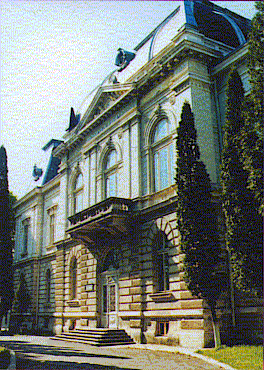
Das ehemalige Landratsamt, heute Museum der Naturwissenschaften
Das ehemalige Landratsamt, heute Museum der Naturwissenschaften ist ein Architektur-Denkmal von lokalem Interesse, situiert auf die Strasse „Alexandru Ioan Cuza“, Nr. 43 (LMI-Code – BT-II-m-B-01970).
Das Barockgebäude datiert aus 1887 und das Museum wurde in 1953 durch die Bemühungen einer Gruppe von Lehrern gegründet. Das Gebäude wurde von französischen Architekten entworfen, um das Landratsamt des ehemaligen Kreises zu beherbergen.
Heute verfügt das Museum über 17 Messehallen, davon neun den Naturgeschichtestücke gewidmet, und 8 Galerien zeitgenössischer Kunst im Rahmen der Kunstgewerbemuseen. Dazu gehören 1985, in Dorohoi bei der Glasfabrik hergestellten Gemälde und Exponate von Glas und Porzellan.
Das Museum enthält natürliche Stücke aus allen systematischen Gruppen: Mineralien, Pflanzen, Muscheln, Fische, Vögel und Säugetiere. Unter den Exponaten befindet sich die Sammlung von seltenen exotischen Schmetterlinge (Lepidoptera) der Apotheker Wilhelm Weber, aber auch die entomologische Sammlung des Lehrers John Nemeș, betrachtet die dritte am Niveau des Landes im Hinblick auf den wissenschaftlichen Wert – hat etwa 105.000 Exemplare von Schmetterlingen in allen Regionen, aber auch aus verschiedenen Teilen der Welt.
Hier kann auch die Sammlung von echten, exotischen Vögeln aus Afrika darüber hinaus vom Professor Cătălin bewundert werden. Herausragende Beispiele, wie die langohrige Feldlerche, Schneevogel oder Ente mit Perücke, sind zu erkennen.
Neben diesen Exponaten im Museum befinden sich auch wunderbare lebende Exemplare von Vögeln und exotischen Fischen, die den gesamten natürlichen Rahmen beleben.
L’ancienne Préfecture, actuellement le Musée de Sciences Naturelles
L’ancienne Préfecture, actuellement le Musée de Sciences Naturelles est un monument architectural d’intérêt local, situé 43 rue ”Alexandru Ioan Cuza” (Cod LMI – BT-II-m-B-01970).
L’édifice en style baroque date de 1887, et le musée a été créé en 1953 grâce aux efforts d’un collectif de professeurs. Le bâtiment a été projeté par des architectes français pour être le siège de la préfecture de l’ancien département de Dorohoï.
À présent, le musée dispose de 17 salles d’exposition, dont 9 destinée aux pièces d’histoire naturelle et 8 aux galeries d’art contemporain, dans le cadre du Musée d’Art Décoratif. Celles-ci incluent des peintures aussi que des objets en verre et en porcelaine, réalisés en 1985 à la fabrique de verre de Dorohoï.
Le musée comprend des pièces naturelles de tous les groupes systématiques : des minéraux, des plantes, des mollusques, des poissons, des oiseaux et des mammifères. Parmi les objets exposés ont retrouve la collection de lépidoptères exotiques rares (papillons) du pharmacien Wilhem Weber, mais aussi la collection entomologique du professeur Ioan Nemeș, considérée comme la troisième du pays du point de vue de la valeur scientifique – elle inclut environ 105.000 exemplaires de papillons de toutes les régions du pays mais aussi de divers coins du monde.
C’est toujours ici qu’on peut admirer la collection d’oiseaux autochtones et exotiques, provenant de l’Afrique et non seulement, du professeur Rang Cătălin. On peut y voir des exemplaires remarquables tels l’alouette haussecol, le bruant des neiges ou la nette rousse.
À côté de tout cela, on trouve également dans le musée des merveilleux exemplaires vivants d’oiseaux et de poissons exotiques, qui animent tout le cadre naturel exposé.
The Former Prefecture, the current Museum of Natural Sciences
The Former Prefecture, the current Museum of Natural Sciences is an architectural monument of local interest, situated on 43 “Alexandru Ioan Cuza” Street (Code LMI – BT-II-m-B-01970).
The baroque building dates from 1887, while the museum was set up in 1953 through the efforts of a group of professors. The building was designed by French architects to house the Prefecture of the former Dorohoi County.
The museum accommodates 17 exhibition halls, 9 of which are dedicated to Natural History exhibits, and 8 to galleries of contemporary art, within the Museum of Decorative Arts. These include paintings as well as glass and porcelain exhibits made in 1985 at the glass factory in Dorohoi.
The museum comprises natural exhibits from all systematic groups: minerals, plants, molluscs, fish, birds and mammals. The collection of rare exotic lepidoptera (butterflies) belonging to the pharmacist Wilhelm Weber, and the entomological collection belonging to professor Ioan Nemeș, considered to be the third in the country in terms of scientific value – including approximately 105,000 specimens of butterflies from all the regions of Romania, as well as from various areas of the world – are just a few of the exhibits.
The collection of autochthonous and exotic birds from Africa and not only, belonging to professor Rang Cătălin, can also be admired in this museum. Remarkable specimens such as the Horned lark, the Snow bunting or the Red-crested pochard can also be viewed.
Wonderful specimens of live exotic birds and fish, which give life to the entire natural setting of the museum, are also found among the exhibits.

Magazinul de biciclete ActivExplore
Site – www.activexplore.ro
Adresa
Str Mihail Kogalniceanu Nr.1 Botosani
Telefon
0721.229.365
0231.516.608
0721.229.365
0231.516.608
Program magazin
Luni-Vineri 10:00 – 18:00
Sambata: 10:00 – 14:00
Luni-Vineri 10:00 – 18:00
Sambata: 10:00 – 14:00

Cornișa – AquaPark & Sports
Un patinoar acoperit, cu o capacitate de 250 de locuri, dar şi mai multe terenuri de mini-fotbal şi tenis au fost deschise, vineri seară, în interiorul Parcului regional de agrement Cornişa din municipiul Botoşani.
Patinoarul va fi deschis zilnic între orele 10.00 – 22.00
Informații pe site-ul www.cornisaparc.ro
Tur Virtual: https://real-tour-ro.captur3d.io/view/cornisa-aquapark-sports/tur-virtual?fbclid=IwAR1BNSXk4-JkpL7g1hP-4SN1dSpwf3UJ_y32c1X6MTs5LaNUb5hD0BtVFX8

Evenimente
|
NR. CRT. |
EVENIMENT |
PERIOADA APROXIMATIVĂ DE DESFĂȘURARE
|
|
1. |
Zilele „Mihai Eminescu”
|
15 ianuarie |
|
2. |
Zilele Orașului
|
23 aprilie |
|
3. |
Zilele „Nicolae Iorga”
|
Luna iunie |
|
4. |
Concerte estivale cu muzică de promenadă în Parcul „Mihai Eminescu”
|
Mai – Septembrie |
|
5. |
Crosul Primăverii Botoșani
|
|
|
6. |
Cupa Primăriei la sporturi
|
|
|
7. |
Galerie Expozițională Permanentă „Botoșani: Atunci și Acum”
|
|
|
8. |
Festivalul de Tradiții și Obiceiuri (parteneriat cu Consiliul Județean)
|
Luna decembrie |
|
9. |
Târgul Meșteșugarilor (parteneriat cu Consiliul Județean)
|
Luna august |
|
10. |
Concurs Național de Argumentare Retrorică (parteneriat cu Colegiul Național „Mihai Eminescu” Botoșani)
|
|
|
11. |
Concurs Interjudețean de Matematică „Dimitrie Pompeiu”
|
8 – 10 mai |
|
12. |
Tabăra Internațională de Pictură „Timpul…pentru Mihai Eminescu” ediția a II-a
|
Luna august |
|
13. |
Festivalul SummerFest 2015
|
Luna august |
|
14. |
Manifestări dedicate „Sărbătorilor de Iarnă”
|
Luna decembrie |
|
15. |
Alte activități care vor fi propuse de ONG-uri în cadrul Programului de Finanțări Nerambursabile
|
În cursul anului |

