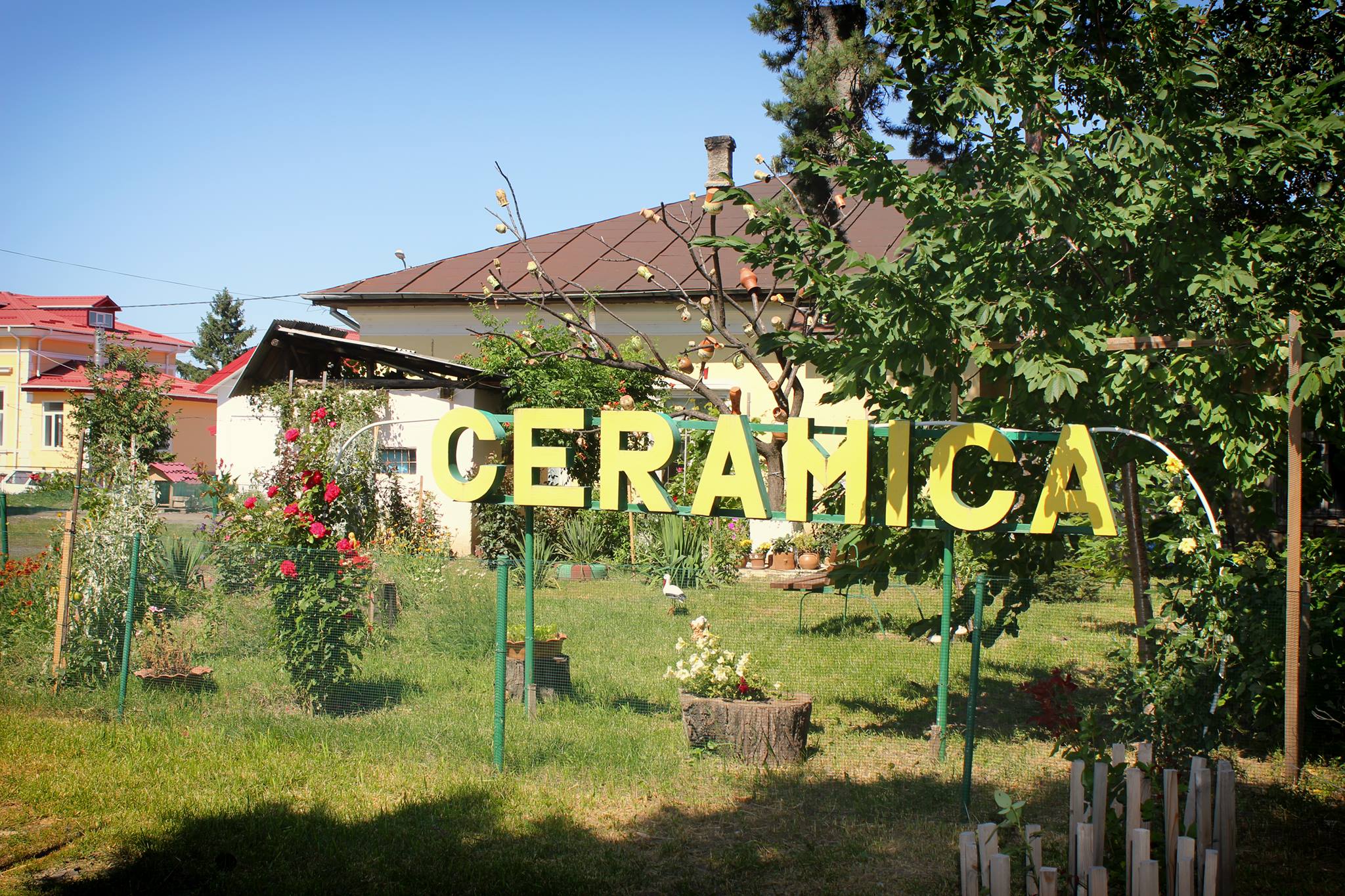
The Iacinschi Kuty Pottery Workshop

Eusebiu Iacinschi, the son of Sonia Iacinschi, is a well-known folk craftsman, famous for the highly skilled creation of Kuty-type ceramics dating from the Middle Ages (thirteenth century).

His vessels are known throughout the world because they are characterized by a specific chromatic base, composed of only three earth colors: green, yellow and brown. The decoration is individualized through the „sgrafitto” technique, which involves drawing some symbols/motifs, through finer or deeper incising of the clay objects. This type of pottery also impresses with a wide range of motifs used: geometric, avimorphic, zoomorphic, anthropomorphic motifs.

The workshop in Botoșani, Kuty Ceramics, which he runs, is the only one in the country where Kuty ceramics are still produced, the sole heir of this Byzantine ceramics.

Its making is a complex process, which involves several stages namely:
1. The processing of clay
2. Clay modeling-vessel formation
3. Drying
4. Incubation
5. Drawing
6. The first burning
7. Coloring
8. Enameling
9. The final burning
Some of the most important distinctions and awards won by the pottery are:
• The letter of thanks for the support given to the 16th edition of the “ROMANIA DAY ON BROADWAY” festival held in New York;
• The First Prize awarded at the XXII edition of the National Exhibition Contest from Moldova, 2011.

Atelierul de Ceramică Kuty al familiei Iacinschi


Una dintre cele mai atractive tehnici din domeniul olăritului din România, ceramica de tip Kuty, supravieţuieşte datorită pasiunii unei familii din Botoşani. Atelierul de ceramică al familiei Iacinschi este singurul din judeţul Botoşani şi al doilea din România, după cel de la Rădăuţi – Suceava, care produce farfurii, căni, sfeşnice, căniţe, castroane, străchini sau obiecte de decor realizate manual după o tehnică practicată începând din secolul al XIV-lea.


Atelierul aparţine Soniei Iacinschi şi fiului acesteia, Eusebiu, doi meşteşugari care stăpânesc arta decorativă şi care s-au impus la nivel naţional şi internaţional, conform Agerpres. Lucrările lor – cu motive decorative unice, zoomorfe si avimorfe, realizate în culorile verde, galben şi brun, au fost valorificate atât în România, cât şi în Franţa, Italia, Israel sau Ungaria. Sonia Iacinschi consideră munca sa zilnică în atelierul din municipiul Botoşani un „rău necesar“. „E mai mult o pasiune decât o afacere. Dintr-o afacere ai un venit substanţial, însă noi abia supravieţuim. Trebuie să ne mai ocupăm şi de altele ca să putem supravieţui. Nu, nu se poate renunţa. Cât mă ţin puterile, nu pot renunţa. Am încercat să renunţ, dar n-am putut“, afirma Soria Iacinschi, care este dezamăgită de faptul că poporul român nu preţuieşte la fel de mult ca şi străinii arta tradiţională.


Arta ceramicii de tip „Kuty”, este un proces complex, care presupune parcurgerea mai multor etape, și anume:

1. Prelucrarea lutului

2. Modelarea argilei – formarea vaselor

3. Uscarea/Zvântarea

4. Angobarea

5. Zgrafitarea

6. Arderea

7. Colorarea

8. Smălțuirea

9. Arderea

Surse: Ziarul lumina, wikipedia

Armenian Cemetery

The oldest Armenian Orthodox church from Moldavia was built in Botosani a fact that denotes the large number of Armenians settled in the city at that time.
The Armenian Ortodox church Saint Mary was bulit in 1350.
The „Eternity” cemetery, which is also the place where the Armenian cemetery is located, an open-air museum of funerary art for 200 years.
Until the mid-nineteenth century Armenian merchants were content with tombstones , but with the increase of their power and wealth, Armenian funeral monuments in Botosani became true symbols of social and financial influence.
However, in 1850, the Armenian funerary art reached its peak, when the Grigoroşianu family donated the land to the Armenian community, arranging it in a well-organized cemetery.
Moreover, in 1855 Ana Pruncul, the wife of the rich Armenian Avedic Van Prumen, built a church to serve this cemetery.
Almost every tomb has an impressive funeral monument which tells the story of the dead. It was a cemetery of the rich people.
Until now there are only 26 funeral monuments left. All of them were made by craftsmen from different cities: Milano, Geneva, Vienna, Athens.
The most impressive monument is that of the Cristea and Maria Manea family, representing a massive coffin on the catafalque, but also details of the family’s life.

Ștefan Luchian Foundation

The „Ştefan Luchian” Foundation, whose name is often referred as „the poet of still life’’ (mainly flowers) was established 20 years ago on the 30th august, 1999 and it’s included in the Ciomac-Cantemir house -a patrimony value from way back the 1800s. The Armenian merchants house’s architecture shows a special detail seen in many newer and older houses from Botoşani: a brâncovenesc veranda. The Ciomac-Cantemir house also includes the memorial house „Ştefan Luchian” and a workshop for traditional creations.
Ștefan Luchian, a great romanian painter, was born in Ștefănești, Botoșani county, in 1868. Due to his parents, he moved to Bucharest with his brother, Anibal. At just 10 years old, his father unfortunately passed away, leaving the two brothers under their mother’s teachings. She was a big adept of military school, forcing the artist to take the military exam entrance, but Ștefan failed the exam on purpose, only to later join the ‘’Belle-Arte’’ art school in Bucharest. His undeniable talent is easily picked from the crowd during his time there, of which he made good use in Germany (Munich) and France. Back from his study-travel, working as a church painter, he meets the daughter of the Mayor from Târgoviște, with whom he falls in love during their painting lessons. He even ask for her hand, but his wealth was unfortunately not enough to convince her parents. The lovers later ran away together, however her parents already found a future husband for their girl. Years after, Ștefan Luchian passing by her house, sees her with two children and a bouquet of anemones, inspiring him to paint one of his famous still life tableau. In 1902, the artist becomes paralysed and continuing his artwork, he manages to create what the most acclaimed critics of Louvre Museum described as: one of the best self portraits in recent history, showing a multitude of emotions different from the pride of being a painter we are used to see in modern paintings. During his last years, Tudor Arghezi was kind enough to visit Luchian and take care of him, before going to work. One morning, according to Arghezi, Ștefan told him that the night before, a young man with a violin started singing, quote: ‘’For the great painter, Ștefan Luchian’’, said the young man who was none other than George Enescu, another national treasure of Romania and Botoșani. Ștefan Luchian later died in 1916, 28 of july. The administration continues and intends to keep alive the cultural legacy our great painter left behind.

Fundația Ștefan Luchian

Fundaţia „Ştefan Luchian“ care poartă numele  „poetului plastic al florilor“, s-a înfiinţat la data de 30 august 1999 și își are sediul în Casa Ciomac – Cantemir, monument istoric datând din anul 1800. Casă de negustori armeni este construită în stil moldovenesc, cu un pridvor brâncovenesc, îl veți vedea în arhitectura  multor case vechi dar și noi din orașul Botoșani.  Fundația își propune să păstreze vie moștenirea culturală pe care ne-a lăsat-o pictorul Ștefan Luchian.  Activitatea culturală intensă a fundației aduce mereu în conștiința noastră, sacrificiul pe care l-a făcut marele pictor pentru artă și în special pentru pictură. În cinstea lui  dar și pentru a promova tinerele talente în acest domeniu se organizează  activități culturale, ateliere de lucru pentru prelucrarea obiectelor conferindu-le valoare artistică.  Sunt deschise expoziții temporare care reactualizează și consolidează bogatul patrimoniu cultural moştenit.

Cimitirul armenesc

Marele istoric român Nicolae Iorga sustinea ca armenii erau printre locuitorii cei mai vechi din Botosani, adaugînd ca „Botosanii ar fi ramas întotdeauna satul descendentilor lui Botas daca n-ar fi fost armenii“.

Cea mai veche biserica ortodoxa armeana din Moldova s-a construit la Botosani, fapt ce denota numarul mare de armeni stabiliti în oras la acea vreme.

Biserica ortodoxa armeana „Sfînta Maria“ din Botosani este cladita în anul 1350 – data cea mai veche cînd este pomenita vreo biserica armeana în tarile Române.

În jurul bisericii „Sfînta Maria“ a existat, conform obiceiurilor timpului, primul cimitir ce cuprindea pietre funerare de marmura, lucrate artistic si cu inscriptii deosebite prin continutul lor, fapt ce l-a determinat pe Nicolae Iorga sa le publice în lucrarea „Inscriptii botosanene“. Iata spre ilustrare un exemplu: „Avedic, Flora. Mormîntul de odihna al cinstitului Avedic Sahag Bolfosul si al sotiei sale Flora“.

Dupa ce cimitirul s-a mutat lînga cel ortodox „Eternitatea“, noile morminte au devenit o veritabila colectie de monumente de o rara frumusete si mare valoare artistica semnate de mari artisti ai genului, de peste hotare: mormîntul lui Garabet Ciolac 1908, monument semnat de R. Streschnak – Viena, medalion din bronz de Hans Bernard – Viena; mormîntul lui Simion si Suzana Ciomac, 1893: monument de Lyvetis si Niforatos; mormîntul lui Avedic si Vartenic Goilav, 1916: monument de D. A. Pellegrinetti – Botosani, mormînt care face parte din patrimoniul de arta plastica al cimitirului armenesc; mormîntul lui Cristea Goilav, 1888, monument de F. Gabiani – Genova etc.

Se cuvine sa spunem cîteva rînduri despre cel care a fost D. A. Pellegrinetti. Nascut în regiunea Carrarei din Italia, a venit spre sfîrsitul secolului al XIX-lea în România împreuna cu alti specialisti pentru a contribui la lucrarile de înfrumusetare (în marmura) a unor mari edificii din Bucuresti. De aici a ajuns la Botosani, în acelasi scop. si-a deschis un atelier pe strada Vînatori în care se executau la comanda monumente de arta plastica.

Missir Haus

Das Missir Haus wurde 1890 im klassizistischen Eklektizismusstil 
erbaut und bietet viele architektonische Besonderheiten, darunter 
den verzierten schmiedeeisernen Zaun.

Die Familie Missir hatte im Laufe der Zeit politische Leute in der 
lokalen Verwaltung von Botoşani, Anwälte und Grundbesitzer in der 
Gegend von Hangu.

Maison Missir

La maison Missir a été construite en 1890 dans un style éclectique 
de style classique et présente de nombreuses caractéristiques 
architecturales d'origine, y compris la clôture en fer forgé ornée.

Au fil du temps, la famille Missir a eu des hommes politiques de 
l’administration locale de Botoşani, des avocats et des propriétaires 
terriens de la région de Hangu.

Missir House

The Missir House was built in 1890 in a classicist eclectic style 
and features many original architectural features, including the 
ornate wrought iron fence.

The Missir family had, over time, political people in the Botoşani
 local administration, lawyers and landowners in the Hangu area.

Garabet Ciomac Haus

Das Garabet Ciomac Haus wurde 1892 erbaut und ist eines der 
repräsentativen Gebäude von Botoşani. Architektur ist eine 
vielseitige, klassizistische Tradition.Garabet Ciomac war 
im 19. Jahrhundert einer der wichtigsten armenischen Kaufleute,
 Botosani, ein großer Landbesitzer und Cattleman.

Auf dem Frontispiz des Gebäudes befinden sich die Initialen des 
Inhabers G. K. - Garabet Kricor Ciomac und das Baujahr.